AI YOUTH COUNCIL
AI YOUTH COUNCIL

AI Medical Scanning Tools – What Kids Think!
Written by Nidhi Patel, AI Youth Council Secretary
What were we discussing?
When people go to hospital, many of them will have a medical imaging test (sometimes called a “scan”) of some kind to find out what is wrong with them. There are many types of “scans” you can have. They are mostly X-rays (to look for things like chest infection, or a broken bone) or ultrasound scans (where you have a jelly put on your skin and they put a special camera on you to see inside – like they do in pregnancy to see the baby) or sometimes more complicated scans like CT or MRI (the ones where you lie on a bed and go inside a machine that looks like a tunnel).
AI can now be used in some cases to help find a medical problem on these medical scans. They do this by looking at thousands of old medical scans – some with problems and some normal – and learning to recognise patterns on these scans. They then apply that pattern recognition to spot medical problems on imaging scans that they have never seen before. The main purpose of this technology is to help patients get an answer to their medical problem faster. The specialist imaging doctors (called radiologists) can issue a report faster, or the doctor seeing the patient (such as the family doctor/GP or emergency doctor) can also sometimes see the AI answer and may be able to take faster action for the patient.
What we did at the AI Youth Council
At the AI Youth Council’s launch day, we asked youths to share what they thought about these AI tools that look for problems on medical scans. We discussed topics like the accuracy, safety, and usefulness of this technology. What would make using these AI tools feel safer for patients, and would children trust a computer to help find illness? These are questions that the AI Youth Council facilitators (Luke, Lauren, Sarah, Caroline, Nathalie) asked during the discussion.
What did children and young people think?
Overall, almost all children and young people said safety of the technology was extremely important when bringing these into the clinical hospital space. Youths still didn’t fully trust an AI scanning tool to get the answer right on its own and wanted to know they could openly discuss and ask questions with their doctors to better understand how the AI would impact their healthcare. They also want to know what happens when AI makes a mistake and the measures taken to prevent errors from occurring.
All age groups highlighted the need for adequately trained imaging specialist doctors (radiologists) to improve the safety of the technology. Most youths agreed that human oversight is always necessary when using the technology, going back to a recurrent theme present throughout the workshop – AI tools should be used in conjunction with a healthcare professional’s expertise.
Differences of opinion across different ages
There were a few key differences in the conversations had between the younger and the older age groups. In the 9-11 age group, there were more questions around how the technology operates in addition to thoughts and comments on the technology itself. There was also more agreement overall in this group, compared to some debate in the 12-15 age group.
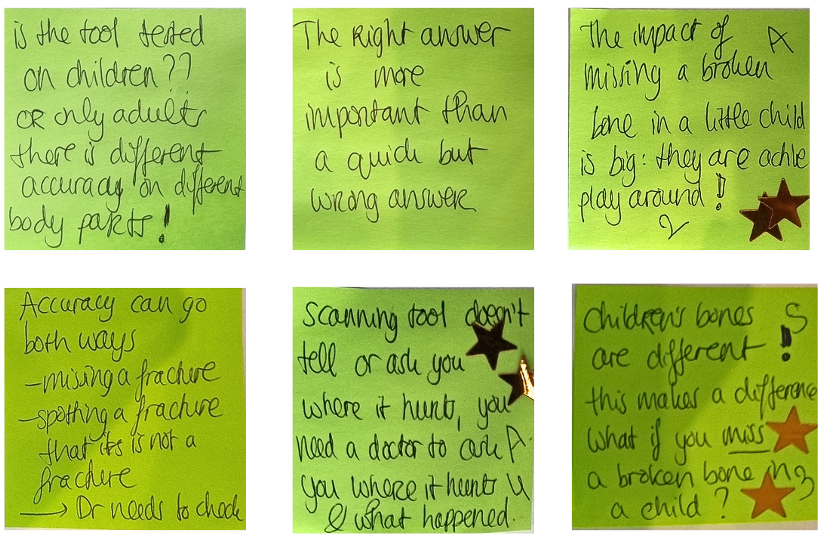
For example, the 9-11 age group explored how the accuracy of the tools might be wrong for some people. They discussed how the accuracy would differ across different age groups and body parts and how inclusive the AI tools might be.
One group member questioned how the accuracy of the tools might differ when trying to diagnose the scan of a 3-year-old and a 10-year-old. This led to a discussion about whether the tool could accurately and reliably pick up different children’s conditions, that maybe adults don’t suffer from. This became an overarching question in the conversation: Were these tools built with children in mind?
The same group also highlighted the importance of adequately trained doctors using the AI tools, and the safety of the tools being put into hospitals. Another group member also said that they believed only allowing experienced doctors to use AI scanning tools would increase their trust in the technology because they thought those doctors would have a better idea what they were doing. Following on from this, one child said a new doctor might not pick up mistakes from the AI tool and questioned how doctors would train with these tools in the future.
This group also worried about what happens when the AI tool makes a mistake. They pointed out that an AI can make mistakes in two different ways: it can miss an injury, or it might flag an injury that isn’t there. They also thought about how these mistakes could impact a child, especially as they grow. For example, one child said, “The impact of missing a broken bone in a little child is big; they aren’t able to play around!” There was general agreement that an accurate diagnosis would be better than a quick but incorrect diagnosis powered by AI.
The older 12–15 age group had additional points in their discussions around privacy, consent, accountability, and how AI scanning tools can be used more broadly in healthcare.
One topic the group explored was how AI scanning tools should be trained. They discussed what steps should be taken when using children’s imaging data to train AI scanning tools. How should privacy be taken into consideration when using this data? When discussing this point, the topic of consent also came up. Should children be required to provide their consent to have their scan data be used to train AI tools? Some in the group thought that they should be informed when their data is used, and others didn’t think that it mattered.
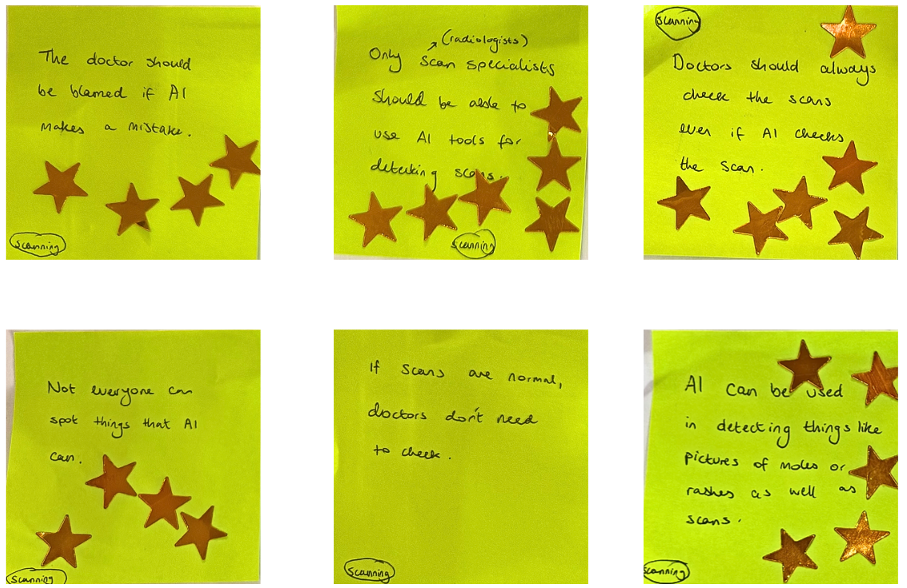
The group considered who should be held accountable if an AI tool makes a mistake. One group member stated that the doctor should ultimately be held responsible because the AI tool should be used only to support the doctor’s expertise.
There was also a conversation around whether doctors are as good as AI, and maybe AI can see things that not all doctors are trained to see on the scans. Therefore, only those trained to look at scans in detail (i.e. radiologists / specialist imaging doctors) should be the ones to use the technology rather than just any doctors in any other specialty because they might not be able to know if the AI is flagging a real problem or not.
The group also thought about potential solutions to prevent AI scanning tools from making errors. One group member proposed systematic safety checks, writing that “AI scans should have random spot checks, like having the scans be checked every third time.” Some group members believed that consistent monitoring would help doctors find errors early and help track how well the tool works.
The group also thought about different applications of AI scanning tools outside of traditional medical scans (X-rays, CT, and MRI scans). One group member proposed that AI could potentially be used in detecting skin conditions, like moles or rashes, from images.
The biggest debate in our conversations was around whether doctors needed to check all scans if the AI was accurate enough (or more accurate than the doctor). One group member suggested that doctors shouldn’t need to review a scan if it comes back as normal by the AI as this could save time. In contrast, other group members thought that doctors should always check the scans even if they use an AI scanning tool to check the scans because it may be wrong or there may be other things on the scan that the AI wasn’t trained to see.
Closing remarks
Overall, it was an engaging discussion that raised a lot of topics for conversation but the one thing that the children did agree on was to keep having an engaged and caring doctor involved in their care who they can trust.
Click on the links below to read more about the specific discussion points for the other AI topics in our workshop, as well as a summary of our Launch Day event.