AI YOUTH COUNCIL
AI YOUTH COUNCIL

AI in Social Care: What’s in it for Kids?
Written by Nidhi Patel, AI Youth Council Secretary
Social care is slightly different but related to healthcare. Doctors and nurses look after our bodies when we are sick. Social care helps us with our daily lives. It is a system of support for people who may be elderly, disabled, and/or going through a tough time, and making sure that they are safe. For children, this would mean making sure they have a safe home, food, caring guardians, and if they have disabilities, then making sure they get the help they need to continue going to school or accessing care and fun activities.
Many children have had some interaction with social care. In fact, it has been said that around a third of all children in England are referred to child social care at least once before turning 18 years old! Sadly, we are seeing the number of children who need social care has been increasing since 2020, and as a result more children are waiting longer for the care they need.
That’s why social workers (people who work in social care) are looking for new ways to help them do their work faster so they can help more children.
How is AI being used in social care?
Since social workers must complete many forms and records for each child they help, they are now using AI with those tasks. A study by The Open University found that AI was most used as virtual assistants, chatbots (more in this article), transcription software (which turns spoken words into text), and AI scribe software (more in this article).
Since last year, Microsoft Copilot (a virtual assistant and chatbot) is now being used by more than 1400 social workers, educational psychologists and support officers in Lancashire County. They use this tool to cut down on the time it takes to create complicated social care assessments – detailed reports summarising chats and information a social worker gathers. Now, reports that used to take up to two days to complete take only three to four hours!
One big benefit of using AI is that it helps social workers who are neurodivergent (this is where someone’s brain works, learns, and processes information differently from most people). A neurodivergent social worker with dyslexia (a condition that makes it hard for a person to read, write, and spell) said that they use an AI tool to transcribe the conversation they had (make voice to text), then put the transcript (the text) they get into another AI tool to summarise it. They said that with the right AI instructions, it can give them detailed case notes.
However, these tools also have downsides. To see exactly what social workers think of AI assistants like Copilot, the Ada Lovelace Institute interviewed social workers with experience of using AI transcription tools, as well as senior staff involved in getting and evaluating them. One social worker said that Copilot often won’t transcribe details about abuse due to safety guardrails, which limits what they can use the tool for. Another social worker said that since Copilot isn’t made for social care, they have to carefully check the assessments. A lot of social workers also worry about how protected the data that they give to AI tools might be.
The North Yorkshire Council also made a proof of concept AI data search tool (a tester tool that proved they could use the concept they thought of) to help social workers find and sort through different kinds of information, like notes and images. This was different to most other tools that did the same as it was made specifically for the children’s social care data system. When they launched it in a controlled environment (with only a few social workers using it), the tools showed a 90% reduction in time and cost for some data retrieval tasks compared to the current system. Although it’s a good start, it’s important to note that it only reduced time and cost for a few tasks, not many.
What do children think?
Unfortunately, there aren’t many AI tools used in social care that are focused on being inclusive for children. Most AI tools that are exclusive to children’s social care are enhanced search tools (like mentioned before) and data mapping tools (which help connect the dots between different data) for social workers. There is also very little about what children think about AI use in social care.
What can you do?
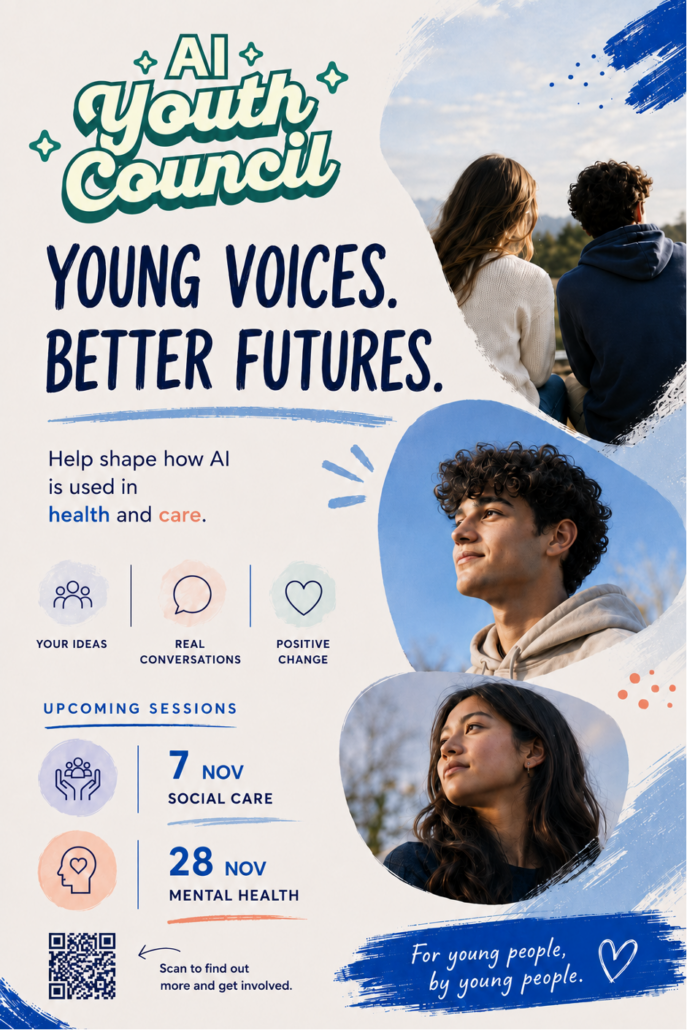
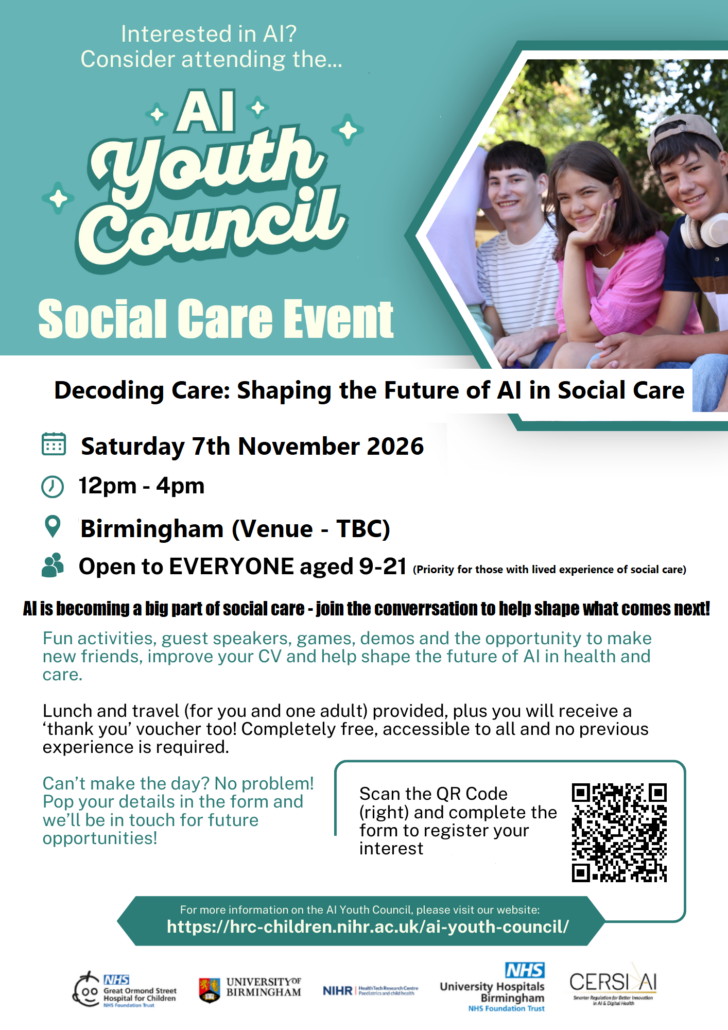
The AI Youth Council wants to change that. We believe that it’s really important that children have their say on how AI is used in health and care. That’s why we’re having an event on social care and AI on the 7th of November 2026 at The Studio in Birmingham, where youth aged 9-21 and their parents are invited to voice their thoughts.
There’ll be guest speakers, activities, and games, with lunch and travel provided.
If you’d like to join, please click the link below to register your interest.