AI YOUTH COUNCIL
AI YOUTH COUNCIL

AI and Mental Health: What’s in it for Kids?
Written by Nidhi Patel, AI Youth Council Secretary
What is mental health and mental healthcare?
Over the last few years, mental health has been widely and openly talked about, taught in schools and online. But what is “mental health” exactly? Some people think it’s being in a good mood all the time, but it’s more than that. Mental health is the overall state of a person’s mind; how they handle stress, relate to others, and function in everyday life. Unlike many diseases (for example cancer) it’s difficult to visualise, can’t easily be measured with numbers, but we can describe emotions, beliefs, moods and impact on our daily lives from mental health.
Sadly, many children struggle maintaining good mental health and understanding their own emotions and feelings from a variety of reasons. In the UK, children and young people who are having mental health struggles can be referred to CYPMHS (Children and Young People’s Mental Health Service), which is a mental healthcare service.
Like with many healthcare services, there are more referrals than there are professionals to process and help these patients. For example, data for 2024-25 shows that 1,048,965 children had an active referral to CYPMHS, which was an almost 10% rise from the previous year! The Royal College of Psychiatrists warns that this could turn treatable conditions into lifelong mental illnesses.
To help more children get the help they need, specialists working in mental healthcare are wondering if AI (artificial intelligence) can both help patients understand themselves and their needs better, potentially deliver some therapies and also ensure that the most severely affected patients get seen sooner on the waiting list.
How is AI being used in mental health?
AI tools for clinicians
Right now, the majority of AI tools in mental healthcare are made for clinician use. These include tools that help clinicians assess their patients, plan treatment, and transcribe their appointments (see our article on AI scribes for more on this).
With the vast amount of data that clinicians need to go through to make a diagnosis for a patient, it can be hard to properly analyse it. This is an area that AI is very good at. It can take information from lots of places, like health records, clinician notes, and patient survey answers, and even voice recordings and videos, and use this information to identify patterns associated with specific mental health conditions. This may mean we can get to a diagnosis much faster or notice things in the notes that humans may otherwise miss or overlook. With a faster diagnosis we can hopefully get patients started on treatment quicker.
Another possibility – while not used in real patients right now – is using AI to analyse what a person is consuming via social media and predict different types of mental health crises from the content they are consuming! A research study on this showed that their AI model was over 85% accurate when making its predictions.
AI can also be used to help clinicians decide what treatment strategy might best help their patient. They can do this by looking at a patient’s characteristics (like their age, gender, and even the medication they’re currently taking) and match this to what other people like them have found helpful and whether or not this patient might stick to their treatment plan. If they know in advance that a patient is unlikely to follow the treatment they recommend, they can make sure a back up plan is in place so that they are not left without any support.
AI tools for patients
There have also been AI tools and tools with AI features designed to directly help people who struggle with maintaining good mental health. Most of these tools are in the form of apps, and there are two main categories that they fall into: chatbot-based therapy and AI-enhanced emotional health apps.
Right now, the two most popular chatbot-based therapy smartphone applications are called Woebot and Wysa. Both operate a bit differently. Woebot only uses the information that has been put into it’s programme and takes that information to make it sound human to explain things to the patient. Unlike other chatbots like ChatGPT or Claude, it is only given information about mental health by trusted experts rather than access to all of the internet, so you can better trust the information it gives out. It also only guides users along set text pathways, limiting when you can type a response. Through this, it provides a therapy type called CBT (which stands for Cognitive Behavioural Therapy), which is a type of talking therapy. In one study, Woebot was shown to significantly reduce the symptoms of depression of the people who used it.
Wysa works similarly, but it also supports patients to get help via the NHS. The main goal of Wysa is to be there for a patient getting help through the NHS the whole way along, including the wait from referral to appointment. This means that even if waiting lists are very long to see a specialist, you are already getting support and reassurance through the application, and can better understand how to navigate the services available to you.
AI tools behind the scenes
Most other mental and emotional health apps use AI behind-the-scenes. For example, Talkspace is an online therapy app that uses AI to match patients with therapists that would best suit their needs. For example you may have problems with feeling depressed or worried all the time, or maybe your problem is that you lost a close relative. In that case, you may want a therapist who has worked in this area or topic before and understands what it’s like. Some people prefer male therapists, other female therapists; or others may wish for someone younger to talk to.
Other smartphone applications like Moodfit or Flourish use AI to track and analyse the user’s mood to help them identify patterns in their mood and develop strategies to manage their emotions. This could mean something like an online journal or diary where you can tell the AI tool about your day and over time it will notice patterns in your moods to help you understand what changes you might need to make. For example, whether you keep having particular arguments with someone in your life, or when you seem like you are happiest. This may give you information on how you want to change your lifestyle or interactions with certain people or hobbies or jobs.
What do children think?
It’s no secret that many children and young people use AI chatbots for maintaining their mental health. In fact, almost one in five young people in the United States (US) have said that they use chatbots in this way, which is more than 8 million people! From a study of over 1000 youths (ages 15-18 years old) in the US that investigated how they felt about integrating AI into youth mental health services, one reason they said they would consider talking to an AI chatbot for their mental health needs is because they know it’s not a real person that can judge them. They also thought that it could be easier to access. However, young people also acknowledge that sometimes, the human part of therapy is reassuring and needed.
In a different study, youths talked about how they would feel if the conversations they had when they accessed mental health services were used to train AI. They thought that this data was much more personal than something like physical health data and wouldn’t feel comfortable sharing it. They mentioned that this was because they felt that mental health wasn’t something that could be measured objectively, unlike physical health.
Another study, based on feedback from parents and youth on an AI-driven tool for psychiatrists (mental health doctors), found that many young people were worried about AI not being able to catch nuances in their conversations. They also wanted to know who would have access to their data, for how long they could access the data, and if it was secure or not. They also asked about where the tool would get its training data.
Right now, the mental health charity Mind is holding a call for evidence on mental health in the age of AI. The current call for evidence is only accepting input from those older than 18 years old, however the commission will include children in the future. Their website states that they aim to bring people together to talk about how AI can affect mental health, including challenges and benefits. They hope to share what they learn in clear reports and guidance to the public that will be fully complete in July of 2027.
At our AI Youth Council Launch event in March 2026, we had a group discussion about what we thought about mental health and chatbots. You can read more about our discussion here.
How can you get involved?
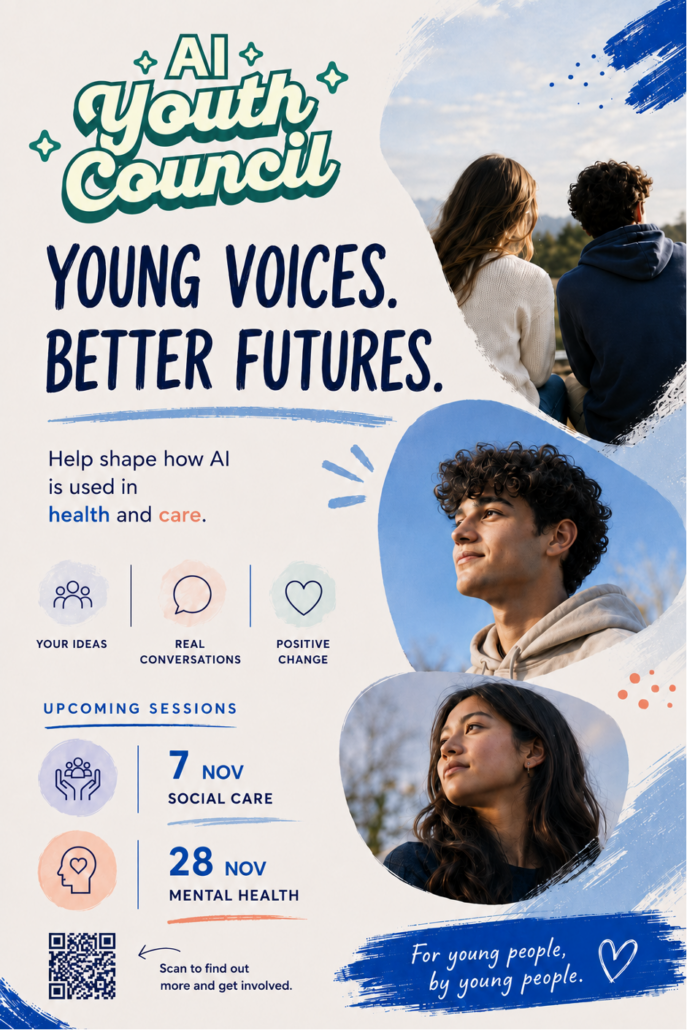
The AI Youth Council is holding an event on mental health and AI on 28th November 2026 at Great Ormond Street Hospital’s DRIVE Unit where you can provide your input and chat to other children and young people about how they feel about AI.
Our event is open to youths aged 9-21 and their parents. This workshop will run from 12 PM to 4 PM. There’ll be guest speakers, activities, and games, with lunch and travel costs provided.
If you’d like to join, please click the link below to register your interest.